
Can’t find what you’re looking for?Reach out to us

    Health and Wellness

    How Long Do IV Fluids Stay in Your Body?

    IV treatment at home

    September 9, 2026

    The IV drip is over, but you may still wonder where all that fluid goes. Does it stay in your body for days, or does your body clear it within hours? The answer isn't quite as simple as either. Anyone asking how long do IV fluids stay in your body is really asking two separate questions: how long the fluid itself lasts, and how long the benefits last.

    IV fluids move through the body's fluid compartments after they are given, and the kidneys remove excess fluid over time. How quickly this happens depends on the type and amount of fluid, why you received it, and your overall health. 

    If the IV also contains vitamins, minerals, or medication, those substances follow their own timelines. Understanding the difference helps set realistic expectations about IV therapy.

    What Goes Into the IV

    What Happens Afterward

    Fluids

    Distributed through the body's fluid compartments, and excess is removed by the kidneys

    Electrolytes

    Used or regulated according to the body's needs

    Vitamins

    Follow their own absorption, metabolism, and storage patterns

    Medications

    Follow drug-specific timelines based on the medicine given

    How Long Does Your Body Keep IV Fluids?

    The fluid itself does not stay long. Most of it is absorbed and processed within a few hours of the infusion ending. The kidneys filter out whatever the body does not need and pass it out as urine, usually within several hours of the drip finishing.

    The nutrients, vitamins, and minerals carried in that fluid do not leave on the same schedule. Some are used up and gone within a day. Others are stored and released slowly over one to three weeks. So, in short, the fluid clears fast. The benefits do not. This is the core of how long do IV fluids stay in your body: the water leaves quickly, but the nutrients don't.


    CTA Background

    Are you looking for a service?

    Enquire Now
    CTA

    What Happens to IV Fluid After the Infusion?

    Four things mostly settle this question, and none of them are the same for every person.

    Hydration level. A well-hydrated body clears extra IV fluid quickly, since it has little use for the surplus. A dehydrated body holds on to most of it instead, using what it needs before letting the rest go.

    Metabolic rate. People with a faster metabolism tend to absorb and clear IV fluids more quickly than people with a slower one.

    The type of fluid. Isotonic fluids, the standard hydration mix, are absorbed and used fairly fast. Hypertonic solutions, used for specific medical situations, tend to stay in the bloodstream longer because of how they draw water across cell membranes.

    General health. Conditions affecting the kidneys or heart can slow down how quickly fluid gets processed and removed.

    How Long Do Different IV Medications and Nutrients Last?

    The answer depends on what was infused, since fluids, medications, vitamins, and minerals each follow different timelines.

    Fluids and electrolytes are the fastest to move through. Their rehydrating effect typically lasts two to three days.

    Water-soluble vitamins, such as vitamin C and the B-complex group, are used within about a day, with any excess passed out in urine. Fat-soluble vitamins, like vitamin D, linger longer and can stay active for a few weeks.

    Minerals such as magnesium and zinc get stored in the body and drawn on as needed, with noticeable effects lasting one to two weeks.

    Antioxidants like glutathione clear from active circulation within a few days, though the reduced inflammation they leave behind can last longer than the compound itself.

    Put together, most people notice initial effects within ten to fifteen minutes of the drip starting, clearer improvements within the hour, and the full range of benefits unfolding over the following three to seven days. This staggered timeline is a big part of why iv fluids benefits are felt well after the drip itself is finished.

    The fluid leaving your body does not mean the treatment has stopped working.

    IV fluids are cleared according to the body's fluid balance, while medications and nutrients follow their own pharmacological timelines.

    Why IV Fluids Benefits Vary From Person to Person

    If someone starts a session already dehydrated, the fluid works harder and often lasts longer, since the body is retaining more of it rather than passing it straight through. That is one reason two people can walk away from the same drip with different results. It's also why iv fluids benefits can feel stronger for one person than another, even on the same type of drip.

    It also explains why sessions are often spaced out rather than daily. Fluids clear in hours, but vitamins and minerals are still working days later, so repeating a session too soon mostly tops up what is already circulating rather than adding something new. Spacing sessions properly is one of the simplest ways to get the most out of iv fluids benefits without wasting a drip.

    IV drip therapy

    Why Do People Choose IV Therapy?

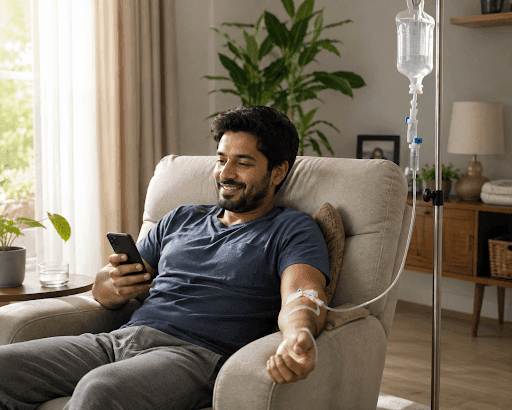
    IV treatment delivers fluids and medications directly into the bloodstream, so they do not need to pass through the digestive system first. This can be useful when someone needs rapid fluid replacement, cannot take enough fluids by mouth, or requires a medication that is best given intravenously. 

    For someone considering IV therapy, the more useful question isn't simply how long the fluid stays in the body or how long does IV therapy last. It's whether the treatment is appropriate in the first place and what it is intended to achieve. That is where proper assessment and monitoring matter, especially when IV therapy is provided at home. People searching for how long does iv therapy last are often really deciding whether the treatment fits their schedule and needs in the first place.

    First Response Healthcare (FRH) provides IV therapy at home with the appropriate assessment, dosing, equipment, and monitoring. A drip that works with your schedule, not against it, needs to be dosed and monitored properly. 

    Alongside it, FRH offers doctor home visits, lab tests at home, home nursing, and teleconsultation, so if a session uncovers something that needs a closer look, the next step is already covered without another trip anywhere.

    For someone considering IV therapy, the more useful question isn't simply how long the fluid stays in the body or how long does iv therapy lasts. It's whether the treatment is appropriate in the first place and what it is intended to achieve. That is where proper assessment and monitoring matter, especially when IV therapy is provided at home. People searching for how long does iv therapy last are often really deciding whether the treatment fits their schedule and needs in the first place.