Search
Can’t find what you’re looking for?Reach out to us


AMH Test at Home

Your personal nurse arrives within 30 minutes.
30
Minutes
JCI Accredited
4.9/5 Highly Rated
Get your AMH test at home in Dubai from the comfort and privacy of your home. Our DHA-licensed nurse collects your blood sample safely, with accurate lab processing and confidential reporting.
Benefits of Our AMH Test at Home
Understand Your Egg Reserve
AMH gives an idea of how many eggs you may have left, helping you better understand your fertility.

Plan Pregnancy with Confidence
Whether you’re trying now or thinking about the future, AMH can help you make informed decisions.


Supports Fertility Treatment Planning
AMH helps doctors understand how your ovaries may respond during treatments like IVF.
Understand Possible Hormonal Imbalances
Unusual AMH levels can signal possible issues such as low ovarian reserve or PCOS, so you can take timely action.

How AMH Testing Helps
Ovarian Reserve Assessment
Measures AMH to estimate remaining egg reserve. Why it matters: Forms the foundation of fertility evaluation.
IVF & Ovarian Stimulation Planning
Helps predict how ovaries may respond to fertility medications. Why it matters: Supports personalized and safer treatment protocols.
Fertility Preservation & Egg Freezing
Assesses ovarian response prior to egg freezing. Why it matters: Helps plan realistically for future pregnancy.
PCOS & Hormonal Evaluation
Higher AMH levels may be seen in PCOS. Why it matters: Contributes to overall reproductive hormone assessment.
Post-Surgery or Medical Treatment Review
AMH may be checked after ovarian surgery or before treatments like chemotherapy. Why it matters: Helps assess potential impact on fertility.
Reproductive Aging Insight
AMH naturally declines with age. Why it matters: Offers perspective on changing fertility over time.
 24/7 UNINTERRUPTED AT-HOME CARE
Here to Support Your Journey
Whether you’re exploring your options or actively trying to conceive, our at-home AMH test in Dubai gives you clear answers with complete privacy.

Understand Your AMH Blood Test Results
A simple reference guide to help you understand what your AMH test results mean.

About AMH Test
What Is an AMH Test?
Anti-Müllerian Hormone (AMH) is a hormone produced by follicles in the ovaries. The AMH test at home in Dubai helps estimate ovarian reserve, meaning the number of eggs remaining. It is commonly used in fertility evaluation and treatment planning.
Who Should Get an AMH Test?
An AMH test is commonly recommended as part of a fertility evaluation and reproductive health assessment. It is suggested for:
- Women planning pregnancy now or in the future
- Women experiencing difficulty conceiving
- Those considering IVF or fertility treatment
- Women with irregular periods or suspected PCOS

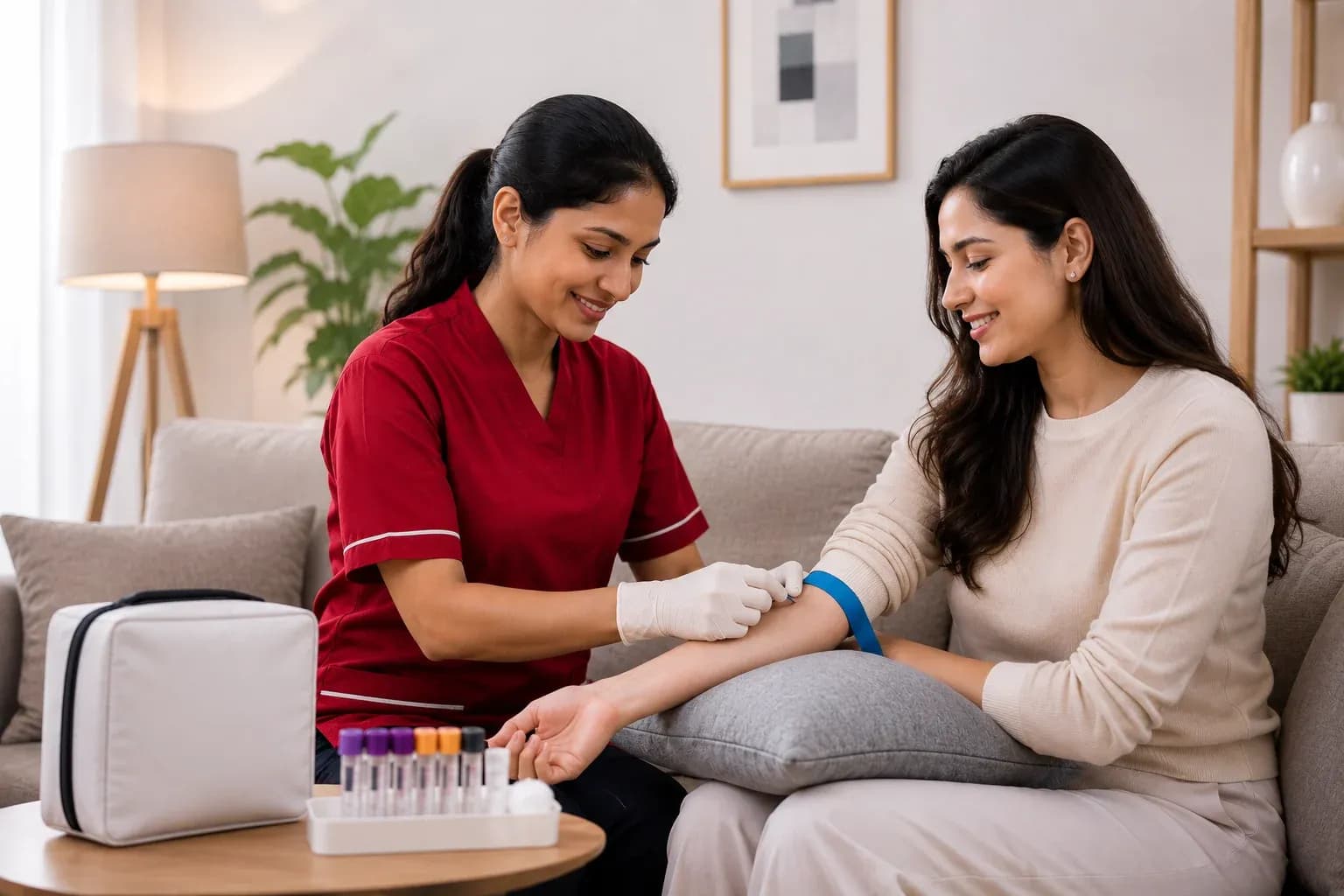
Why Choose Us for AMH Testing at Home
- Sample collection by experienced DHA-licensed professionals
- Processed under JCI-accredited laboratory standards
- 24/7 private and convenient fertility testing at home
- Fast and accurate results with the doctor's review

Hear it from our patients
More Services
Discover all services you can get at home in span of time.
Frequently Asked Questions
An AMH test measures anti-Müllerian hormone levels in your blood to estimate your ovarian reserve, or the number of eggs remaining in your ovaries.
AMH gives an idea of the number of eggs remaining in the ovaries. It does not measure egg quality or guarantee pregnancy outcomes.
No, fasting is not required.
Yes, AMH levels can be tested on any day of the menstrual cycle.
Normal levels vary by age. Results are interpreted based on age-specific reference ranges.
AMH alone cannot diagnose PCOS, but elevated levels may support the diagnosis when combined with other findings.
Yes. AMH helps doctors estimate how the ovaries may respond during IVF.
It is not usually required frequently. Your doctor will advise based on your fertility plans.
Yes. AMH naturally declines with age.
It involves a simple blood draw and is generally quick and well-tolerated.
Results are typically available within 24 hours.
Yes. Your results are handled with complete privacy and confidentiality.

Chat With Our 24/7 Healthcare Expert